

Vertical asymptotes are imaginary vertical lines on a graph where a function becomes undefined and its values grow extremely large in the positive or negative direction. These lines are written in the form x=a, and they show where the function cannot pass through because the output does not exist at that specific input value. In simple terms, they represent points of “breakdown” in a mathematical function, most commonly seen in rational expressions where division by zero occurs. When students learn how to find vertical asymptotes, this concept becomes the foundation for understanding more advanced behavior of graphs in algebra and calculus. A key idea to remember is that the graph will get closer and closer to the asymptote line but will never actually touch or cross it.
This behavior helps mathematicians predict how a function behaves near undefined values, which is useful in many real-world applications such as physics and engineering models where extreme values need to be analyzed carefully.
Step-by-Step Method to Find Vertical Asymptotes
Finding vertical asymptotes becomes much easier when you follow a clear and structured method. The first step is to identify the type of function you are dealing with, and in most cases, vertical asymptotes appear in rational functions where one polynomial is divided by another. The key idea in how to find vertical asymptotes is to focus on the denominator because this is where the function can become undefined.
Start by setting the denominator equal to zero and solving for the values of x. These values are potential vertical asymptotes because division by zero is not defined in mathematics. However, it is important to simplify the expression first if possible, because sometimes factors cancel out and create holes instead of true asymptotes.
After simplifying, any remaining values that still make the denominator zero represent vertical asymptotes. At these points, the function will increase or decrease without bound, meaning the graph will shoot upward or downward infinitely. This step-by-step approach ensures accuracy and helps avoid confusion when dealing with more complex expressions in algebra or calculus.
Factoring Expressions to Identify Asymptotes
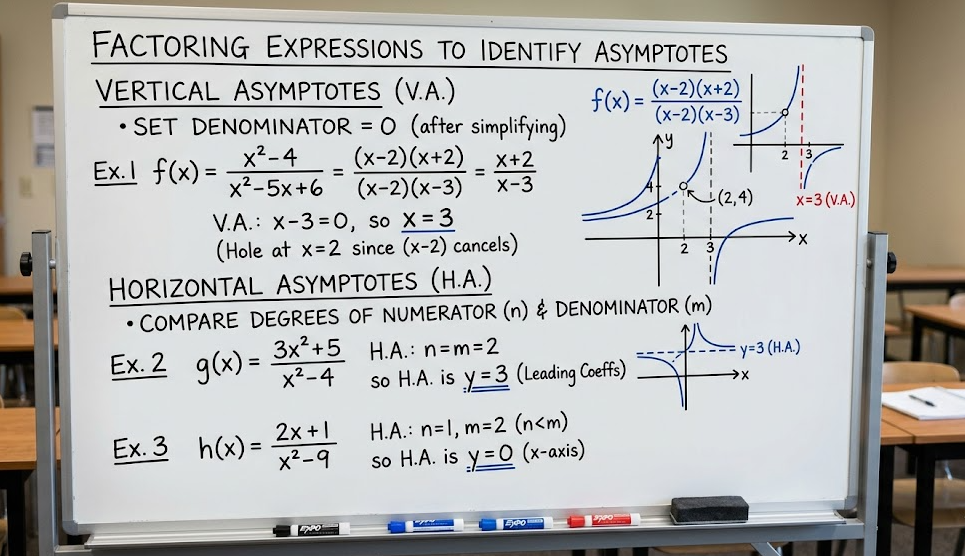
Factoring is one of the most important skills when learning how to find vertical asymptotes because it simplifies complicated expressions into manageable parts. Many rational functions look difficult at first, but once you break them into factors, the structure becomes clear and easier to analyze. The goal is to rewrite both the numerator and denominator in factored form so you can clearly see which values cause the expression to become undefined.
When the denominator is fully factored, you can quickly identify the values that make each factor equal to zero. These values are the main candidates for vertical asymptotes. However, factoring also helps reveal something very important—whether a factor cancels out with the numerator. If a factor cancels, it does not create a vertical asymptote; instead, it creates a removable discontinuity known as a hole.
For example, if a function contains a common factor in both the top and bottom, simplifying it will remove that factor completely. This is why factoring is not just a shortcut but a necessary step in accurately finding vertical asymptotes. It ensures that only the true points of undefined behavior remain in the final answer, making the graph’s behavior more predictable and mathematically correct.
How to Detect and Avoid “Holes” in Functions
When learning how to find vertical asymptotes, it is equally important to understand what does not count as an asymptote. One of the most common mistakes students make is confusing vertical asymptotes with “holes” in a graph. A hole happens when a factor in the numerator and denominator cancels out after simplification, meaning the function is actually undefined at that point, but not infinitely increasing or decreasing.
To detect a hole, you first factor the expression completely and simplify it. If the same factor appears in both the numerator and denominator, it cancels out. The value that made that factor zero is then removed from the domain, but it does not create a vertical line where the graph shoots up or down. Instead, the graph has a missing point, which is shown as an open circle.
Avoiding confusion between holes and vertical asymptotes is critical for accuracy. A vertical asymptote happens only when a factor remains in the denominator after simplification and still equals zero. In contrast, a hole appears when that problematic factor completely cancels out. This distinction helps ensure that you correctly analyze the structure of rational functions and avoid incorrect conclusions about the graph’s behavior.
Using Limits to Confirm Vertical Asymptotes

Limits provide a more advanced and precise way to confirm vertical asymptotes, especially when functions become complex. While algebraic methods like factoring help identify possible asymptotes, limits show what actually happens to the function as it gets closer to a specific x-value. This makes limits an important tool when learning how to find vertical asymptotes in higher-level math.
To use limits, you examine what happens to the function as x approaches a value from the left and from the right. If the function increases or decreases without bound—meaning it goes toward positive infinity or negative infinity—then a vertical asymptote exists at that x-value. This behavior confirms that the graph is not just undefined at that point, but is actually growing without limit.
For example, if both one-sided limits approach infinity (or negative infinity), it clearly indicates a vertical asymptote. However, if the function approaches a finite number instead, then there is no vertical asymptote, even if the expression looked suspicious at first. This method removes doubt and ensures accuracy, especially when dealing with complex rational functions or expressions that are difficult to simplify fully.
Common Mistakes Students Make
When learning how to find vertical asymptotes, many students make avoidable mistakes that lead to incorrect answers. One of the most common errors is forgetting to simplify the function before identifying asymptotes. If you do not factor and cancel common terms first, you may incorrectly label a hole as a vertical asymptote, which changes the entire interpretation of the graph.
Another frequent mistake is assuming that every value that makes the denominator zero is automatically a vertical asymptote. In reality, some of these values disappear after simplification, meaning they only create holes instead of true asymptotes. This is why careful factoring is always necessary before drawing conclusions.
Students also sometimes misread graph behavior and assume a steep curve is a vertical asymptote. However, only behavior where the function increases or decreases without bound near a specific x-value qualifies. A steep but finite curve is not enough. Avoiding these mistakes ensures a clearer understanding of function behavior and helps build strong mathematical accuracy.
Real-World Case Study Example
Vertical asymptotes are not just a classroom concept—they also appear in real-world situations where systems behave unpredictably near certain limits. To understand how to find vertical asymptotes in practice, consider a simple physics-based example involving a function that models pressure in a confined system. As the input variable approaches a critical value, the pressure increases rapidly and becomes extremely large, showing behavior similar to a vertical asymptote.
In many engineering models, rational functions are used to describe how systems respond to changing conditions. For instance, when a denominator in a formula approaches zero, the output grows without bound, indicating that the system is reaching an unstable point. This helps engineers identify safe operating ranges and avoid conditions that could lead to failure or overload.
Another example comes from economics, where supply and demand models sometimes produce curves that spike sharply near certain values. These spikes reflect limitations in real-world systems, such as resource shortages or maximum capacity limits. By analyzing these situations using the concept of vertical asymptotes, professionals can better understand where systems break down and plan accordingly to prevent problems.
Conclusion
Understanding how to find vertical asymptotes is an important skill in algebra and calculus because it helps explain where and why a function becomes undefined. By focusing on the denominator, simplifying expressions, and checking for factors that cancel out, you can accurately identify whether a value creates a vertical asymptote or just a hole. Using limits adds even more clarity by showing how the function behaves as it approaches critical points, especially when values grow without bound.
Overall, vertical asymptotes give deep insight into the behavior of mathematical functions and help connect algebraic rules with real-world applications. Once you master the step-by-step method, recognizing these asymptotes becomes much easier and more intuitive.
FAQs
1. What is a vertical asymptote in simple words?
It is a vertical line where a function becomes undefined and its values increase or decrease without limit.
2. How do I quickly find vertical asymptotes?
Set the denominator of a fraction equal to zero and solve for x, after simplifying the expression.
3. What is the difference between a hole and a vertical asymptote?
A hole appears when a factor cancels out, while a vertical asymptote remains when the denominator is still zero after simplification.
4. Can a graph cross a vertical asymptote?
No, a function can get very close to a vertical asymptote but it will never touch or cross it.
For More, Visit Accurate Unit Convert














Leave a Reply