
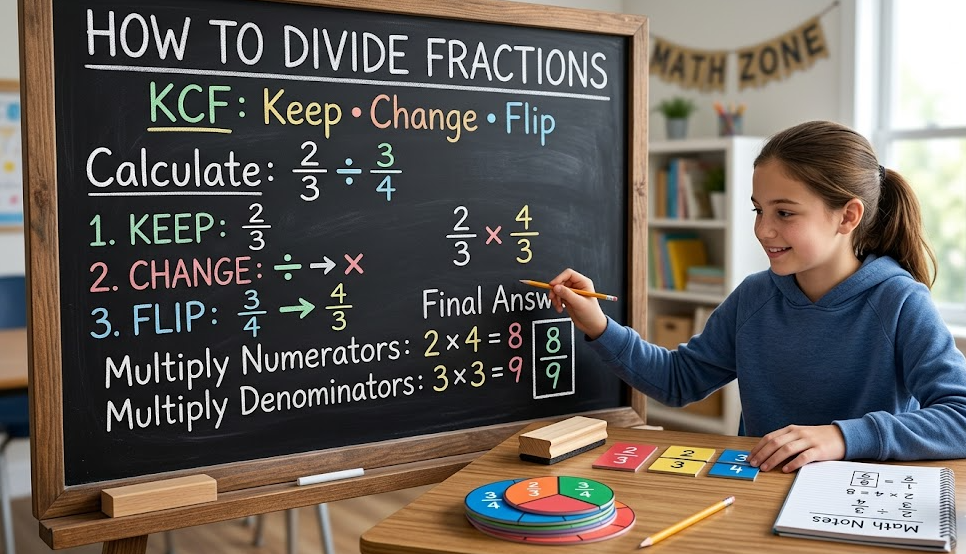
How to divide fractions becomes much easier when you understand the “Keep, Change, Flip” rule, which is the most important shortcut used in fraction division. This rule helps convert a division problem into a multiplication problem so it becomes simpler to solve. First, you keep the first fraction exactly the same, then you change the division sign into multiplication, and finally you flip the second fraction by switching its numerator and denominator. This method is widely taught because it removes confusion and reduces calculation errors, especially for beginners learning how to divide fractions for the first time.
Step-by-Step Example of Dividing Fractions
How to divide fractions becomes much clearer when you look at a simple step-by-step example. Suppose you want to solve 43÷52. First, you keep the first fraction as it is, so 43 stays unchanged. Next, you change the division sign into multiplication. Then you flip the second fraction, turning 52 into 25. Now the problem becomes 43×25, which you solve by multiplying numerators and denominators. This gives 815, which can also be written as a mixed number 187. This step-by-step process shows clearly how how to divide fractions works in a structured and easy way, making even complex problems manageable for beginners.
Dividing Fractions by Whole Numbers
How to divide fractions by whole numbers becomes simple once you understand that every whole number can be written as a fraction. For example, the number 4 can be written as 14. This helps convert the problem into a standard fraction division question. First, you rewrite the whole number as a fraction, then apply the same “Keep, Change, Flip” rule used in regular fraction division. This approach ensures consistency and reduces confusion when solving problems involving mixed forms.
Why this method works is because division rules stay the same whether you are working with whole numbers or fractions. For example, if you have 65÷3, you change 3 into 13, flip it to 31, and multiply. The final answer becomes 185. This shows how how to divide fractions applies even when whole numbers are involved, making it a universal math strategy.
Common Mistakes Students Make
How to divide fractions correctly often depends on avoiding common mistakes that many students make when they are first learning the process. One of the biggest errors is forgetting to flip the second fraction during the “Keep, Change, Flip” step. This small mistake can completely change the final answer and lead to confusion. Another frequent mistake is multiplying straight across without changing the division sign, which shows a misunderstanding of the rule.
Why these mistakes happen is usually because students try to memorize steps without understanding the logic behind them. For example, some learners forget that division must be converted into multiplication first. Others fail to simplify the final answer, leaving fractions in a more complex form than necessary. Understanding how to divide fractions properly means slowing down, following each step carefully, and double-checking the final result for accuracy.
Real-Life Uses of Fraction Division
How to divide fractions is not just a classroom skill; it is something people use in real life more often than they realize. In cooking, for example, recipes often need to be adjusted. If a recipe calls for half a cup of flour but you only want to make a quarter of the recipe, fraction division helps you figure out the exact amount needed. This makes cooking more accurate and prevents waste.
Why this matters in daily life is because fractions are everywhere in practical situations like construction, budgeting, and measurements. Builders often divide materials into equal parts, while shoppers may split quantities or prices. Understanding how to divide fractions helps people make better decisions, save time, and avoid errors when working with measurements or shared resources.
Simple Practice Tips for Beginners
How to divide fractions becomes much easier when you practice regularly using simple and consistent methods. One effective tip is to start with easy problems, such as fractions with small numbers, before moving to more complex ones. This helps build confidence and strengthens your understanding of each step in the process. Repetition is key, so solving a few problems daily can make a big difference in learning speed.
Why practice is so important is because fraction division is a skill that improves with experience rather than memorization. Writing each step clearly—Keep, Change, Flip—helps reduce mistakes and improves accuracy over time. Using visual aids like pie charts or number lines can also help beginners understand how to divide fractions in a more practical and visual way, making learning both easier and more engaging.
Conclusion
How to divide fractions becomes simple once you understand the basic rule of keeping the first fraction, changing the division sign, and flipping the second fraction. This method turns a complex-looking problem into an easy multiplication process. When you practice regularly and focus on understanding each step, you build confidence and accuracy in solving fraction problems.
Why learning this skill is important is because fractions are used in many real-life situations such as cooking, measurements, and budgeting. Mastering how to divide fractions helps you solve everyday math problems more quickly and correctly, making it a valuable skill for both school and daily life.
FAQs
How to divide fractions easily?
You use the “Keep, Change, Flip” rule to turn division into multiplication and then solve normally.
Why do we flip the second fraction?
You flip it because division of fractions is converted into multiplication using reciprocals.
What is the first step in dividing fractions?
The first step is to keep the first fraction unchanged.
Can whole numbers be divided as fractions?
Yes, you convert whole numbers into fractions like 14 before dividing.
For More Visit Accurate Unit Convert













Leave a Reply