
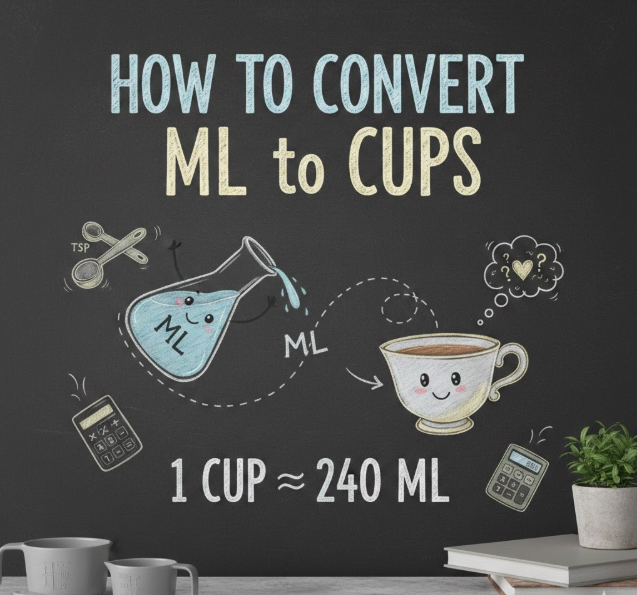
Understanding how to convert ml to cups is an essential skill for cooking, baking, nutrition tracking, and everyday measurements. Whether you are following an international recipe, measuring liquids accurately, or converting metric values into familiar cup sizes, this guide will help you master the process with confidence.
Milliliters (ml) are commonly used in metric systems, while cups are widely used in the US, UK, and other regions. Because cup sizes vary by country, many people feel confused when converting between the two. This article removes that confusion by explaining the formulas, variations, real-world examples, and practical tips in detail.
By the end of this guide, you will know exactly how to convert ml to cups, no matter the liquid or context.
What Does It Mean to Convert ML to Cups?
Converting milliliters to cups means changing a volume measurement from the metric system into a cup-based measurement system.
Milliliters measure volume precisely using the metric system, while cups are a standardized household measurement. The challenge arises because one cup does not equal the same number of milliliters everywhere, which is why understanding the context is critical.
Why ML to Cups Conversion Is Important
• Converting ml to cups ensures accuracy in cooking and baking, especially when following international recipes that list ingredients in milliliters. Incorrect conversions can alter taste, texture, and consistency.
• Many measuring tools display only one unit. Knowing how to convert ml to cups allows you to work confidently even when you lack the correct measuring cup.
• Nutrition tracking often requires cup measurements, while beverages and liquids are labeled in ml. Conversion helps maintain accuracy in dietary planning.
• Scientific precision matters in recipes involving liquids like milk, water, and oils. Even small measurement errors can affect results.
• Understanding conversions builds confidence and reduces dependency on calculators or apps.
• It improves kitchen efficiency by allowing faster, mental estimations during food preparation.
Also Read:- How to Convert Binary to Decimal – Complete Beginner to Advanced Guide
Cup Measurements Around the World
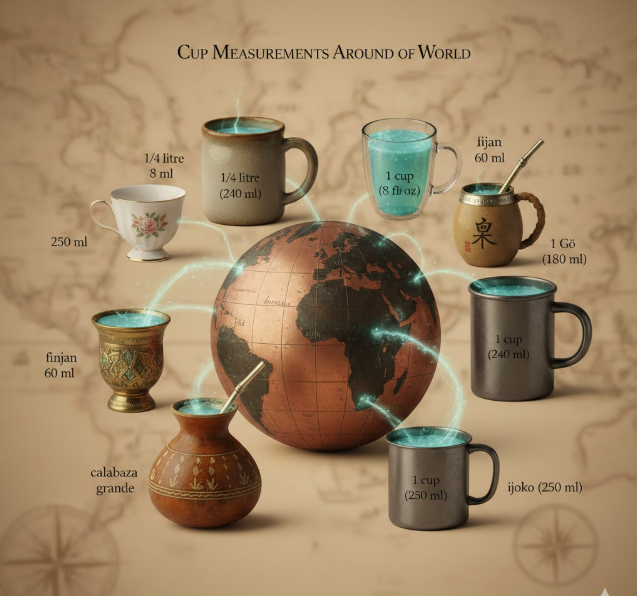
Before learning the formula, it’s important to understand that cup sizes vary depending on location. This variation is the main reason many people struggle with convert ml to cups calculations.
Common Cup Standards Explained
• The US cup equals 240 ml, making it the most commonly used measurement in American recipes and cooking guides.
• The metric cup, used in many countries, equals 250 ml, offering a rounded and simplified measurement.
• The UK cup historically measured 284 ml, though modern UK recipes often use metric measurements.
• Japanese cups typically equal 200 ml, especially in rice cooking and traditional recipes.
• Australian cups are metric-based and equal 250 ml, similar to international standards.
• Online recipes may not specify the cup type, making it essential to identify the recipe’s origin.
Also Read:- How Many Centimeters in an Inch? Exact Answer & Examples
How to Convert ML to Cups Formula
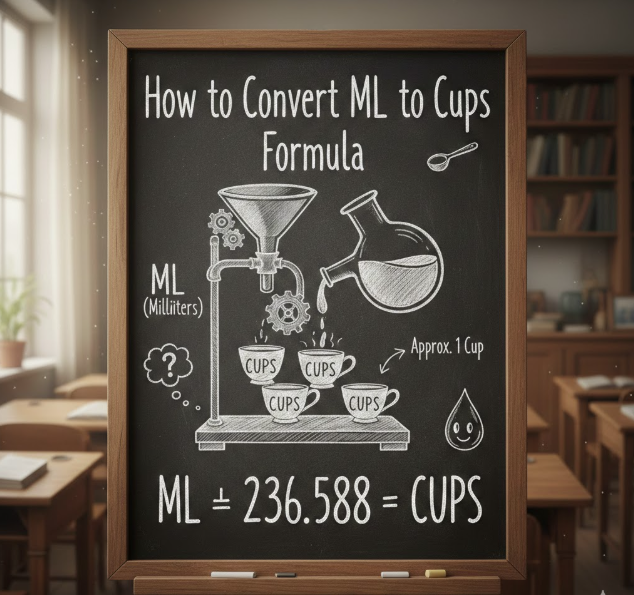
The most reliable way to convert ml to cups is by using a simple mathematical formula. Once you know which cup standard applies, the calculation becomes straightforward.
Basic Conversion Formula
Cups = Milliliters ÷ Cup Size in ml
For example:
• US cup → ml ÷ 240
• Metric cup → ml ÷ 250
Why This Formula Works
• Milliliters are a precise unit, making them ideal for mathematical division.
• Dividing by the cup size converts the total volume into cup units.
• The formula adapts easily to different cup standards.
• It allows for both exact and approximate conversions.
• It works for all liquids, including water, milk, oils, and juices.
• The formula is universally accepted in cooking and food science.
Convert ML to Cups Step-by-Step Method
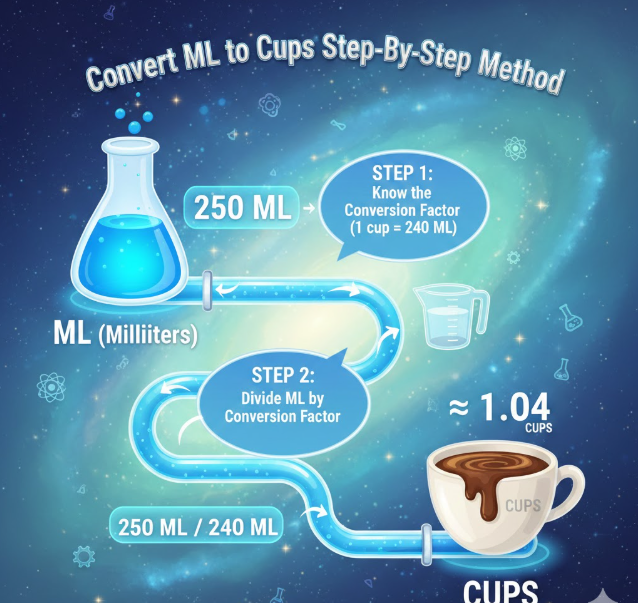
Learning how to convert ml to cups becomes easier when broken into clear steps. This method works for all liquids.
Simple Step Process
• Identify the type of cup measurement used in the recipe or region to avoid incorrect conversions.
• Write down the volume in milliliters you want to convert.
• Choose the correct cup size in milliliters (240 ml or 250 ml).
• Divide the milliliter value by the cup size.
• Round the result if the recipe allows flexibility.
• Double-check your calculation to ensure accuracy.
Also Read:- How to Convert cm to Inche – Simple Formula & Examples
Convert ML to Cups of Water
Water is the most commonly converted liquid because it is used in nearly every recipe. Since water has a consistent density, conversions are straightforward.
Water Conversion Explained
• 240 ml of water equals exactly 1 US cup, making it easy to remember.
• 250 ml of water equals 1 metric cup, commonly used outside the US.
• 120 ml of water equals ½ cup in US measurements.
• 60 ml of water equals ¼ cup, useful for small quantities.
• Water measurements are often forgiving, but precision matters in baking.
• Using a liquid measuring cup improves accuracy for water conversions.
Also Read:- How to Prepare Oysters: The Ultimate Guide for Beginners and Pros
Convert ML to Cups Water (Everyday Use)
Many people search for convert ml to cups water when measuring drinks, soups, or hydration needs.
Practical Daily Examples
A standard glass of water often holds around 240 ml, equivalent to one cup.
A water bottle labeled 500 ml equals approximately 2 cups (metric).
1000 ml of water equals 4 metric cups or just over 4 US cups.
Water conversions are commonly used in fitness and hydration tracking.
Understanding water measurements helps in meal prep and portion control.
Accurate conversions prevent under- or over-consumption.
Convert ML to Cups Milk
Milk is thicker than water, but its volume conversion remains the same because ml measures volume, not weight.
Milk Conversion Details
• 240 ml of milk equals 1 US cup, just like water.
• 250 ml of milk equals 1 metric cup, commonly used internationally.
• Milk conversions are essential in baking for texture and moisture balance.
• Recipes often require precise milk measurements for consistency.
• Fat content does not affect volume conversion.
• Always use a liquid measuring cup for milk accuracy.
Convert ML to Cups Liquid (All Liquids)

When converting any liquid, the same principles apply regardless of density.
Universal Liquid Conversion Rules
Volume measurements remain consistent across liquids.
Oils, juices, broths, and sauces convert the same way as water.
Density affects weight, not volume.
Always check if the recipe specifies US or metric cups.
Use transparent measuring cups for visibility.
Avoid using dry cups for liquid measurements.
Common ML to Cups Conversion Table (Reference)
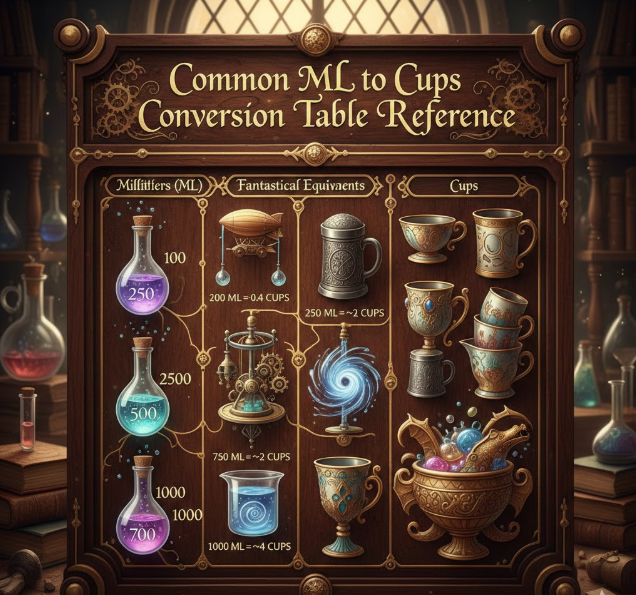
Although formulas are best, having common values memorized saves time.
Popular Conversions Explained
60 ml equals ¼ cup, useful for small portions.
120 ml equals ½ cup, common in sauces and liquids.
180 ml equals ¾ cup, often used in cooking.
240 ml equals 1 cup (US standard).
250 ml equals 1 metric cup.
500 ml equals 2 cups (metric).
Mistakes to Avoid When Converting ML to Cups
Even small errors can affect results, especially in baking.
Common Conversion Errors
Confusing US cups with metric cups leads to incorrect results.
Using dry measuring cups for liquids reduces accuracy.
Rounding too aggressively can ruin precision recipes.
Ignoring recipe origin causes mismatched measurements.
Estimating without reference increases risk of error.
Forgetting cup variations leads to inconsistency.
Best Tools to Convert ML to Cups Accurately
Modern tools simplify conversions and reduce guesswork.
Recommended Measurement Tools
Liquid measuring cups with ml and cup markings.
Digital kitchen scales with volume conversion features.
Mobile conversion apps for quick calculations.
Online calculators for instant accuracy.
Printable conversion charts for kitchen reference.
Measuring spoons for small ml values.
Frequently Asked Questions (FAQs)
How many ml are in one cup?
One US cup equals 240 ml, while one metric cup equals 250 ml.
Is converting ml to cups exact?
It is exact when using the correct cup standard.
Can I convert ml to cups for all liquids?
Yes, volume-based conversions apply to all liquids.
Why do recipes use different cup sizes?
Different countries follow different measurement systems.
Is milk conversion different from water?
No, both convert the same by volume.
What is the easiest way to convert ml to cups?
Divide milliliters by the cup size used in the recipe.
Conclusion:
Learning how to convert ml to cups removes confusion from cooking, baking, and daily measurement tasks. By understanding cup variations, using the correct formula, and applying practical examples, you can convert any liquid confidently and accurately.
Accurate measurements lead to better outcomes—and now, you have the complete knowledge to convert ml to cups the right way.
For More Visit Accurate Unit Convert












Leave a Reply