
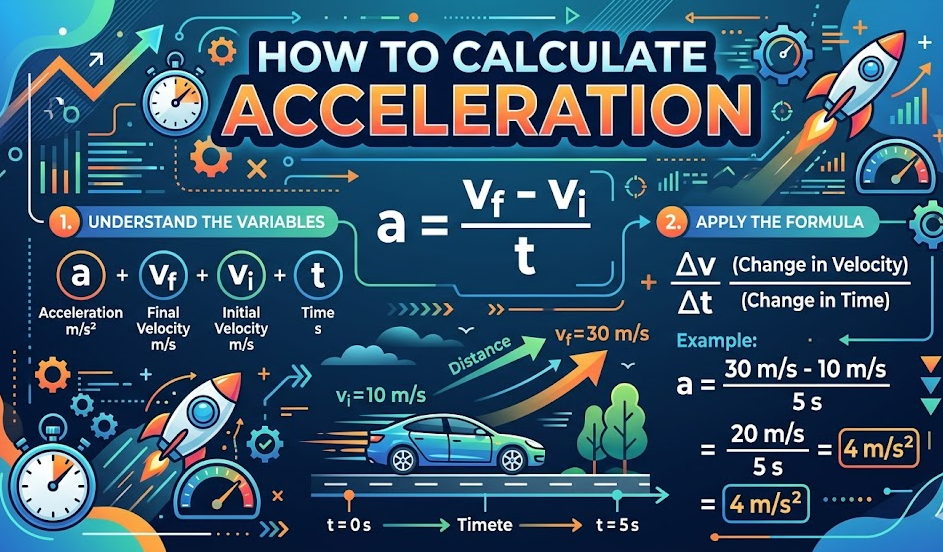
How to calculate acceleration is one of the most essential skills in physics and everyday problem-solving. Whether you’re a student, engineer, or just curious about motion, acceleration explains how objects change their speed or direction over time. From cars speeding up on a highway to objects falling due to gravity, acceleration is everywhere.
In this comprehensive guide, you’ll learn how to calculate acceleration in physics, explore different formulas, and understand practical applications using real-life examples. We’ll also cover variations like how to calculate acceleration from velocity, how to calculate acceleration with force and mass, and even more advanced cases like friction and gravity.
What Is Acceleration in Physics?
Acceleration is defined as the rate of change of velocity with respect to time. Velocity includes both speed and direction, so acceleration can occur when an object speeds up, slows down, or changes direction.
For example, when a car increases its speed, it accelerates. When it brakes, it still accelerates—but in the opposite direction, often called deceleration.
Acceleration is measured in meters per second squared (m/s²).
How to Calculate Acceleration Formula
At its core, the formula for acceleration is simple and widely used:
a=tv−u
Where
a represents acceleration
v represents final velocity
u represents initial velocity
t represents time
This equation is fundamental when learning how to calculate acceleration formula and forms the basis for most motion calculations.
How to Calculate Acceleration from Velocity
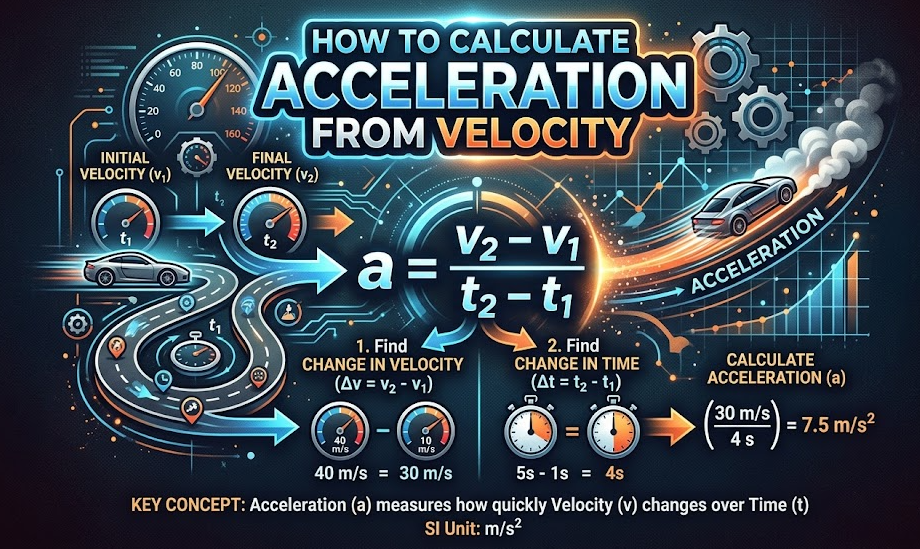
One of the most common methods is calculating acceleration using velocity change over time.
Suppose a car increases its velocity from 10 m/s to 30 m/s in 5 seconds. Using the formula:
Acceleration equals change in velocity divided by time.
So the change in velocity is 30 minus 10, which equals 20 m/s. Dividing by 5 seconds gives an acceleration of 4 m/s².
This method is widely used in both academic problems and real-world physics applications. It directly answers the question of how to calculate acceleration from velocity.
How to Calculate Acceleration with Distance and Time
Sometimes velocity values are not given. In such cases, you can calculate acceleration using distance and time.
The relevant equation is derived from motion laws:
Distance equals initial velocity multiplied by time plus half of acceleration multiplied by time squared.
If the object starts from rest, initial velocity becomes zero, simplifying the calculation.
For example, if an object travels 20 meters in 4 seconds from rest, acceleration can be calculated by rearranging the formula. Solving gives acceleration as 2.5 m/s².
This approach is essential when learning how to calculate acceleration with distance and time, especially in motion problems without velocity data.
How to Calculate Acceleration with Force and Mass
Another powerful method comes from Newton’s Second Law of Motion. It states that force equals mass times acceleration.
Rearranging the formula gives:
Acceleration equals force divided by mass.
For instance, if a force of 50 newtons acts on an object with a mass of 10 kilograms, the acceleration is 5 m/s².
This is the standard way to solve problems involving forces, making it critical when studying how to calculate acceleration with force and mass.
How to Calculate Acceleration Due to Gravity
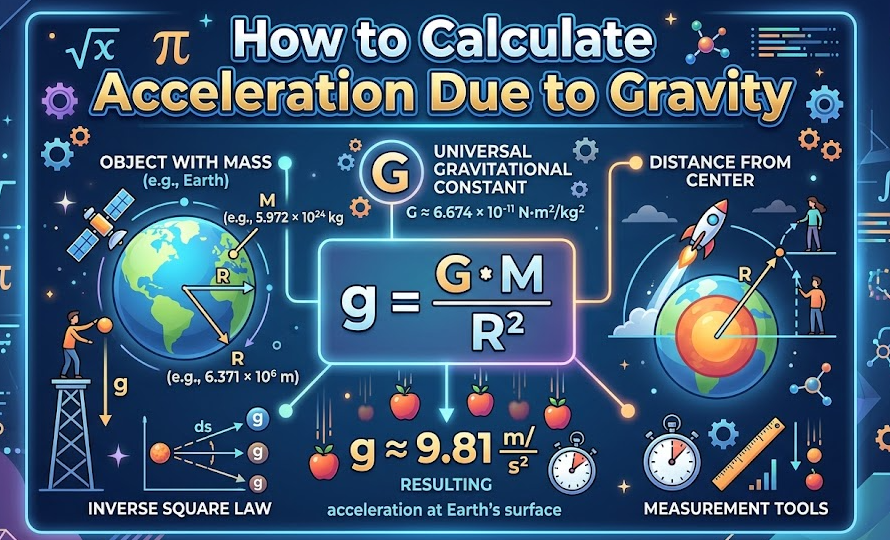
Gravity is a constant acceleration acting on objects near the Earth’s surface. The acceleration due to gravity is approximately 9.8 m/s² downward.
When calculating motion under gravity, this constant is used directly. For example, if an object is dropped from rest, its velocity increases by 9.8 m/s every second.
Understanding how to calculate acceleration due to gravity is crucial in physics, especially for free-fall problems and projectile motion.
How to Calculate Acceleration with Friction
Friction is a force that opposes motion, and it affects acceleration significantly.
To calculate acceleration with friction, you first determine the net force acting on the object. This includes subtracting frictional force from the applied force.
Once the net force is found, you apply Newton’s Second Law:
Acceleration equals net force divided by mass.
For example, if a 100-newton force is applied and friction is 20 newtons, the net force becomes 80 newtons. If the mass is 10 kilograms, acceleration is 8 m/s².
This method is key when learning how to calculate acceleration with friction, especially in real-world physics problems where resistance cannot be ignored.
How to Calculate Acceleration in Physics: Step-by-Step Approach
To master how to calculate acceleration in physics, follow a structured approach.
First, identify the known variables such as velocity, time, distance, force, or mass.
Second, choose the correct formula based on the given data.
Third, substitute the values carefully into the equation.
Fourth, solve and check the units to ensure the answer is in m/s².
This method ensures accuracy and helps avoid common mistakes.
Common Mistakes When Calculating Acceleration
Many learners make avoidable errors when solving acceleration problems.
One common mistake is confusing velocity with speed. Since acceleration depends on velocity, direction must be considered.
Another error is using incorrect units. Always convert values into standard units like meters and seconds.
Some also forget to account for negative acceleration when objects slow down.
Avoiding these mistakes will improve accuracy and understanding.
Advanced Concepts Related to Acceleration
As you progress, you’ll encounter more complex topics.
Vector acceleration involves direction and magnitude.
Angular acceleration deals with rotational motion.
Variable acceleration occurs when acceleration changes over time.
These concepts build upon the basics of how to calculate acceleration in physics.
Conclusion
Learning how to calculate acceleration is a fundamental skill that opens the door to understanding motion, forces, and real-world mechanics. From simple velocity changes to complex scenarios involving gravity and friction, acceleration plays a central role in physics.
By mastering formulas, practicing examples, and applying concepts in real-life situations, you can confidently solve any acceleration problem. Whether you’re calculating motion in a classroom or analyzing systems in engineering, this knowledge is essential and widely applicable.
For More Visit Accurate Unit Convert














Leave a Reply