
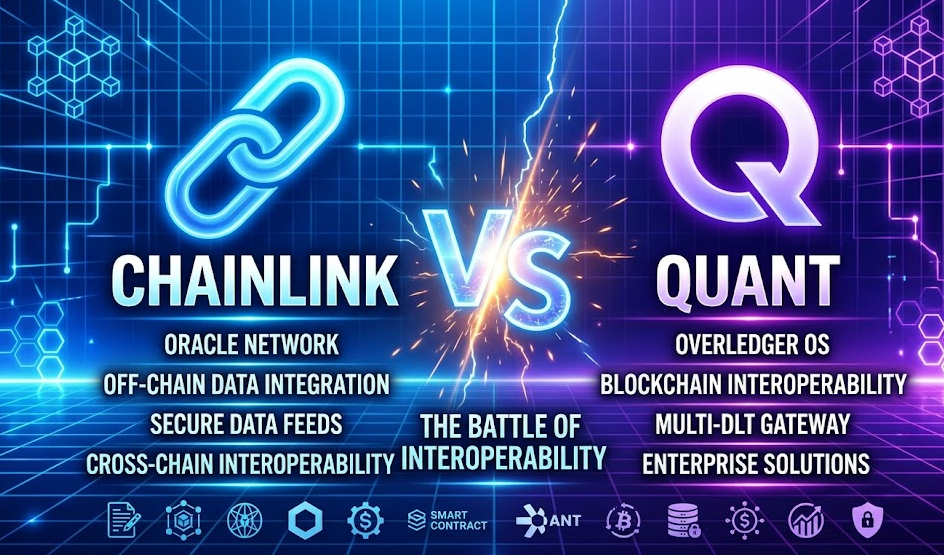
Chainlink is a decentralized oracle network that solves one of the most important limitations in blockchain technology: the inability of smart contracts to directly access real-world data. Blockchains are highly secure and self-contained systems, but they cannot natively interact with external information such as market prices, weather conditions, sports results, or financial data. Chainlink bridges this gap by delivering verified external data to smart contracts in a secure and decentralized way.
This functionality makes Chainlink a core infrastructure layer for decentralized finance (DeFi) and Web3 applications. Many blockchain-based platforms rely on Chainlink’s price feeds to execute trades, lending, and derivatives contracts accurately. Without reliable data input, smart contracts would not function correctly in real-world scenarios. Chainlink also supports cross-chain communication through its interoperability framework, allowing different blockchain networks to exchange information securely.
What Is Quant and Its Role in Enterprise Blockchain
Quant is a blockchain interoperability project designed with a completely different focus compared to Chainlink. Instead of serving decentralized applications, Quant targets enterprises, financial institutions, and governments that need secure connectivity between multiple blockchain networks and legacy systems. Its main product, Overledger, acts as an operating system that allows different blockchains and traditional databases to communicate seamlessly.
Unlike decentralized oracle networks, Quant operates more like an enterprise software layer. It simplifies integration for institutions that want to adopt blockchain technology without rebuilding their entire infrastructure. This makes Quant especially relevant for central banks, fintech companies, and organizations working on digital currency systems and regulated blockchain adoption.
Chainlink vs Quant: Core Technology Differences
When comparing chainlink vs quant, the most important difference lies in architecture and design philosophy. Chainlink is built as a decentralized network of independent nodes that securely fetch and verify external data. It is designed to reduce trust assumptions and operate within public blockchain ecosystems. Its structure supports DeFi applications, where transparency and decentralization are critical.
Quant, however, uses a centralized interoperability approach through its Overledger technology. Instead of relying on decentralized nodes, it functions as an API-based system that connects multiple blockchains and enterprise systems. This makes it more suitable for institutions that require controlled environments, compliance, and integration with existing financial infrastructure. In short, Chainlink prioritizes decentralization, while Quant prioritizes enterprise usability and regulatory compatibility.
Chainlink vs Quant
| Feature | Chainlink (LINK) | Quant (QNT) |
|---|---|---|
| Core Purpose | Decentralized oracle network for real-world data | Enterprise blockchain interoperability OS |
| Main Focus | Web3, DeFi, smart contracts | Banks, governments, financial institutions |
| Technology Type | Decentralized node network | Overledger (API-based system) |
| Interoperability | Cross-chain communication via CCIP | Connects blockchains + legacy systems |
| Architecture Style | Trust-minimized & decentralized | Permissioned & enterprise-controlled |
| Primary Users | DeFi protocols, developers, crypto apps | Enterprises, fintech, central banks |
| Token Utility | Pays oracle node operators, secures data feeds | Used as license/access for Overledger |
| Security Model | Distributed validation (high decentralization) | Controlled enterprise security model |
| Scalability | High for DeFi ecosystems | High for institutional integration |
| Adoption Area | Web3, NFTs, DeFi platforms | CBDCs, banking systems, enterprise IT |
| Market Narrative | Backbone of decentralized finance | Bridge for traditional finance into blockchain |
| Risk Profile | Market-driven crypto adoption risk | Institutional adoption dependency |
Real-World Use Cases and Industry Adoption
Chainlink powers decentralized finance platforms, NFT ecosystems, and blockchain-based gaming applications. Developers integrate its price feeds into lending protocols, derivatives markets, and stablecoin systems, which makes it a foundational layer of DeFi infrastructure. Developers depend on Chainlink because it delivers secure, tamper-resistant data that enables accurate and automated financial execution.
Quant, on the other hand, attracts growing interest from the institutional sector. Central banks and financial institutions explore it for central bank digital currencies (CBDCs), cross-border payments, and enterprise blockchain integration. These institutions prefer Quant’s structured approach because it lets them adopt blockchain technology while maintaining control over internal systems and staying aligned with regulatory requirements. This difference in adoption clearly shows the divide between their target markets.
Token Utility: LINK vs QNT Explained
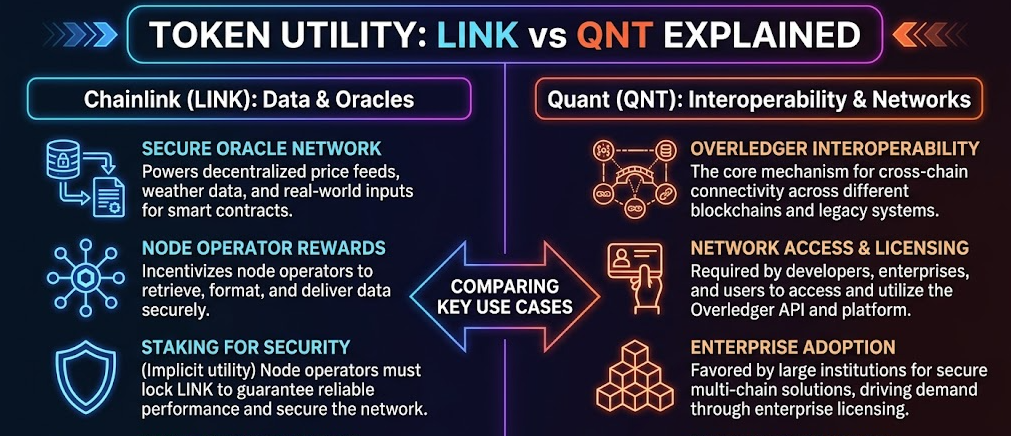
The token utility in chainlink vs quant also reflects their different ecosystems. Chainlink’s token, LINK, is used to pay node operators who provide data to the network. It also helps secure the oracle system by incentivizing honest participation and ensuring reliable data delivery across decentralized applications.
Quant’s token, QNT, functions more like a license key for accessing the Overledger network. Enterprises must hold QNT to use Quant’s services and connect to different blockchain systems. This creates a fixed-supply, access-based utility model rather than a usage-based reward system. As a result, LINK is tied to network activity in DeFi, while QNT is tied to enterprise adoption and licensing demand.
Security, Scalability, and Network Design Comparison
Security is a key factor in the chainlink vs quant comparison. Chainlink uses decentralized nodes to ensure data accuracy and prevent manipulation. This distributed structure increases security by eliminating single points of failure, making it highly resilient for financial applications in DeFi.
Quant focuses on controlled integration environments, which prioritize compliance and enterprise-grade security. Instead of decentralization, it emphasizes permissioned access and structured communication between systems. While this approach may not match Chainlink’s decentralization level, it offers scalability and reliability for institutional use cases where regulatory compliance is essential.
Investment Perspective: Market Position and Long-Term Outlook
From an investment perspective, Chainlink and Quant serve different market narratives. Chainlink sits deeply inside the growing DeFi and Web3 ecosystem, which continues to expand through new blockchain applications, tokenized assets, and cross-chain protocols. Its demand directly follows overall blockchain usage and developer adoption, so increased on-chain activity usually drives stronger utility for the network.
Quant’s growth depends more on institutional blockchain adoption, central bank initiatives, and enterprise-level integration. This market often moves more slowly, but it can scale significantly if traditional financial systems shift toward blockchain infrastructure. Both assets show different risk and reward profiles, depending on whether blockchain growth comes mainly from open DeFi ecosystems or regulated institutional finance.
Final Comparison Summary: Which One Leads the Future?
In the chainlink vs quant debate, there is no direct winner because both projects are solving different layers of the blockchain ecosystem. Chainlink leads in decentralized infrastructure, powering DeFi and Web3 applications with secure data and cross-chain communication. Quant leads in enterprise interoperability, enabling banks and institutions to connect blockchain systems with traditional finance.
Ultimately, Chainlink represents the future of open decentralized networks, while Quant represents the future of regulated institutional blockchain adoption. The long-term success of each will depend on how the global financial system evolves and how quickly blockchain technology is integrated into mainstream industries.
FAQs
1. Is Chainlink better than Quant?
Not directly—Chainlink is better for DeFi and Web3, while Quant is better for enterprise and banking systems.
2. What is the main difference between Chainlink and Quant?
Chainlink is decentralized oracle infrastructure, while Quant is an enterprise blockchain interoperability operating system.
3. Can Chainlink and Quant be competitors?
They are not direct competitors because they target different markets and use cases.
4. Which has more long-term potential, LINK or QNT?
Both have strong potential depending on whether blockchain adoption grows more in DeFi or institutional finance.
For More UpdateS Visit: Accurate Unit Convert














Leave a Reply