
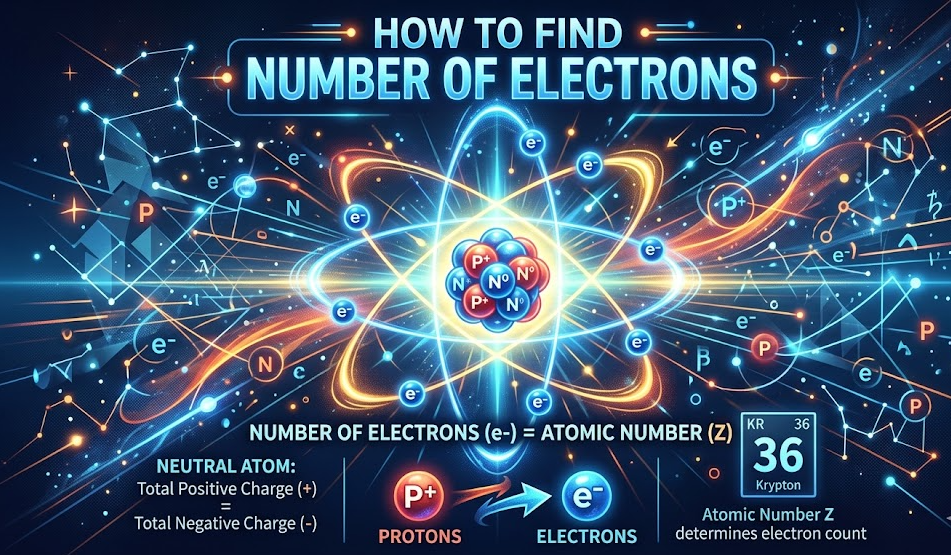
How to find number of electrons is one of the most fundamental concepts in chemistry and physics. Whether you’re a student preparing for exams, a science enthusiast, or someone revisiting basic atomic structure, mastering this concept will unlock a deeper understanding of how matter behaves.
What Are Electrons? (Quick Overview)
Electrons are negatively charged subatomic particles that orbit the nucleus of an atom. They are essential for:
- Chemical bonding
- Electricity and conductivity
- Atomic stability
Each atom contains three main particles:
- Protons (positive charge)
- Neutrons (neutral)
- Electrons (negative charge)
The number of electrons directly influences how an atom behaves chemically.
How to Find Number of Electrons in an Atom
The simplest way to determine electrons in an atom is by using the atomic number.
Key Rule:
For a neutral atom:
Number of electrons = Number of protons = Atomic number
Example:
- Oxygen has atomic number 8
- Therefore:
Electrons = 8
This rule works perfectly for all neutral atoms.
Why This Works
Atoms are electrically neutral by default. That means:
- Positive charges (protons) = Negative charges (electrons)
So if an atom has 11 protons, it must also have 11 electrons.
Also Read:- How to Calculate Formal Charge (Step-by-Step Guide)
How to Find Number of Electrons on Periodic Table
The periodic table is your best tool for finding electrons quickly.
Step-by-Step Method:
- Locate the element on the periodic table
- Find its atomic number (top number)
- That number equals electrons (for neutral atoms)
Example:
- Sodium (Na)
- Atomic number = 11
- Number of electrons = 11
Pro Tip
The periodic table provides more than just electrons—it also helps you understand:
- Electron arrangement
- Energy levels
- Chemical properties
How to Find Number of Electrons in an Element
An element is made up of atoms of the same type. So the process is identical.
Formula:
Electrons = Atomic number
Example:
- Carbon
- Atomic number = 6
- Electrons = 6
This answers the common question: how to find number of electrons in carbon—it’s simply 6 in its neutral state.
How to Find Number of Electrons in Ions
Not all atoms are neutral. Some gain or lose electrons and become ions.
Rules:
- Positive ion (cation): loses electrons
- Negative ion (anion): gains electrons
Formula:
Electrons = Atomic number ± charge
Examples:
Sodium ion (Na⁺)
- Atomic number = 11
- Charge = +1
- Electrons = 11 − 1 = 10
Chloride ion (Cl⁻)
- Atomic number = 17
- Charge = −1
- Electrons = 17 + 1 = 18
How to Find Number of Electrons in a Compound
A compound consists of multiple atoms bonded together. To find total electrons:
Step-by-Step:
- Identify each element
- Find atomic number of each
- Multiply by number of atoms
- Add all electrons together
Example: Water (H₂O)
- Hydrogen (H): 1 electron × 2 = 2
- Oxygen (O): 8 electrons × 1 = 8
Total electrons = 2 + 8 = 10 electrons
Another Example: Carbon Dioxide (CO₂)
- Carbon: 6 electrons
- Oxygen: 8 × 2 = 16
Total = 6 + 16 = 22 electrons
This is the standard method for how to find number of electrons in a compound.
Also Read:- How to Convert Radians to Degrees (Easy Guide)
How to Find Number of Electrons in Energy Levels
Electrons are arranged in energy levels (shells) around the nucleus.
Formula:
Maximum electrons in a shell =
2n²
Where:
- n = shell number
Examples:
- First shell (n=1): 2(1²) = 2 electrons
- Second shell (n=2): 2(2²) = 8 electrons
- Third shell (n=3): 2(3²) = 18 electrons
Example: Sodium (11 electrons)
Arrangement:
- First shell: 2
- Second shell: 8
- Third shell: 1
This explains how electrons are distributed in real atoms.
How to Find Number of Electrons Formula (General Overview)
Depending on the situation, different formulas apply.
1. Neutral Atom
Electrons = Atomic number
2. Ion
Electrons = Atomic number − charge (for positive ions)
Electrons = Atomic number + charge (for negative ions)
3. Energy Levels
Electrons = 2n²
4. Compounds
Total electrons = Sum of electrons of all atoms.
How to Find Number of Electrons in Physics
In physics, especially electricity and atomic theory, electrons are often calculated differently.
Using Charge Formula:
Number of electrons = Total charge / Charge of one electron
Where:
- Charge of one electron = 1.602 × 10⁻¹⁹ coulombs
Example:
If total charge = 3.2 × 10⁻¹⁹ C
Number of electrons =
(3.2 × 10⁻¹⁹) / (1.602 × 10⁻¹⁹) ≈ 2 electrons
Applications in Physics
- Electric current
- Conductivity
- Semiconductor behavior
- Electrolysis
Real-World Importance of Electron Calculation
Understanding how to find number of electrons is not just academic—it has real-world applications:
Chemistry
- Predicting reactions
- Bond formation
Physics
- Electricity and circuits
- Atomic models
Technology
- Semiconductors
- Batteries and energy storage
Conclusion
Mastering how to find number of electrons is a foundational skill that opens the door to deeper understanding in both chemistry and physics. From identifying electrons in a single atom to calculating them in complex compounds or energy levels, the process becomes straightforward once you understand the rules.
FAQs
How to find numbers of electrons in an atom quickly?
Just look at the atomic number. That equals the number of electrons in a neutral atom.
How to find numbers of electrons in carbon?
Carbon has atomic number 6, so it has 6 electrons.
How to find numbers of electrons in a compound?
Add the electrons from each atom in the compound.
How to find numbers of electrons in energy levels?
Use the formula 2n² to determine maximum electrons per shell.
How to find numbers of electrons in physics problems?
Divide total charge by the charge of one electron (1.602 × 10⁻¹⁹ C).
How to find numbers of electrons on periodic table?
Locate the atomic number—it directly gives the number of electrons.
For More Visit Accurate Unit Convert














Leave a Reply