
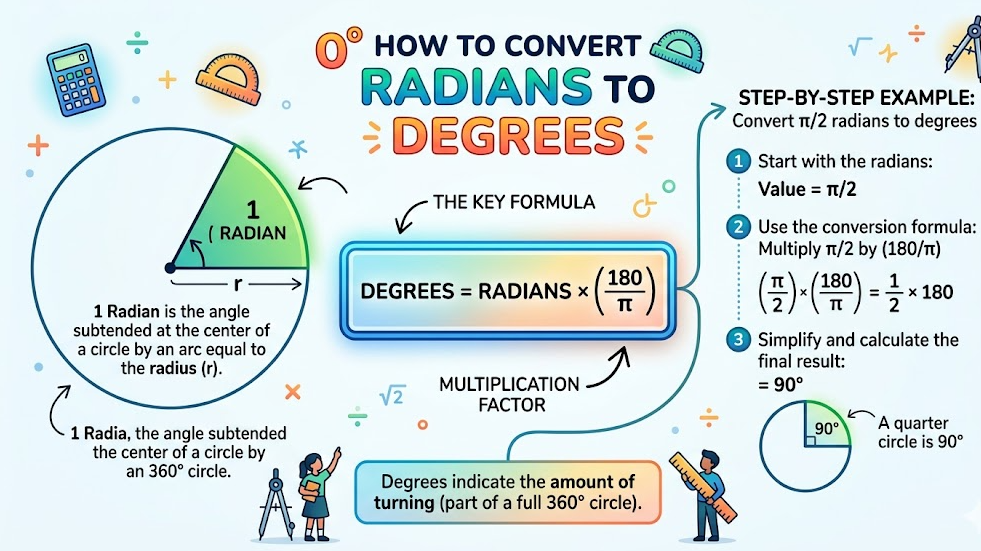
How to convert radians to degrees is an essential math skill used in geometry, trigonometry, physics, engineering, and programming. Whether you’re a student solving math problems, a developer writing code, or someone working with angles in real-world applications, mastering this conversion will save you time and improve accuracy.
Radians and degrees are simply two different units for measuring angles. While degrees are more commonly used in everyday life, radians are preferred in advanced mathematics and science. This guide will walk you through everything you need to know—from the basic formula to calculator tricks, Excel usage, and programming examples in Java and Python.
What Are Radians and Degrees?
Before learning how to convert radians to degrees, it’s important to understand what these units represent.
Degrees divide a circle into 360 equal parts. If you’ve ever measured an angle in school, you’ve likely used degrees. A right angle is 90°, a straight line is 180°, and a full circle is 360°.
Radians, on the other hand, are based on the radius of a circle. One radian is the angle formed when the arc length equals the radius. A full circle equals approximately 6.283 radians, which is also written as 2π.
Radians are widely used in higher mathematics because they simplify many formulas, especially in trigonometry and calculus.
Why Convert Radians to Degrees?
You might wonder why you need to convert between radians and degrees at all. The answer depends on the context.
In mathematics and physics, radians are often preferred because they make equations cleaner and easier to work with. However, in everyday applications like navigation, construction, and design, degrees are easier to interpret.
That’s why knowing how to convert radians to degrees is essential—it allows you to switch between systems depending on your needs.
Also Read:- How to Convert 4 Meters to Feet
How to Convert Radians to Degrees Formula
The most important part of this guide is the conversion formula. Once you understand it, everything else becomes straightforward.
The formula is:
Degrees = Radians × (180 ÷ π)
This works because π radians is equal to 180 degrees. By multiplying radians by 180/π, you convert the value into degrees.
For example, if you have 1 radian:
Degrees = 1 × (180 ÷ π) ≈ 57.2958°
So, 1 radian is approximately 57.3 degrees.
Step-by-Step Example
Let’s walk through a simple example to understand how to convert radians to degrees.
Suppose you want to convert 2 radians into degrees.
First, use the formula:
Degrees = 2 × (180 ÷ π)
Now calculate:
Degrees ≈ 2 × 57.2958
Degrees ≈ 114.59°
So, 2 radians equals approximately 114.59 degrees.
This method works for any value, whether it’s a whole number, fraction, or decimal.
Common Radian to Degree Conversions
Some radian values appear frequently in math problems. It’s helpful to memorize these:
π/6 radians = 30°
π/4 radians = 45°
π/3 radians = 60°
π/2 radians = 90°
π radians = 180°
2π radians = 360°
Recognizing these standard conversions can speed up problem-solving and reduce calculation errors.
How to Convert Radians to Degrees on Calculator
If you’re using a scientific calculator, converting radians to degrees is quick and easy.
Most calculators have a built-in conversion function or allow you to perform the formula directly.
Start by entering the radian value. Then multiply it by 180 and divide by π. Many calculators have a π button, so you don’t need to type the value manually.
For example, to convert 3 radians:
Enter:
3 × 180 ÷ π
Press equals, and you’ll get approximately 171.89°.
Some advanced calculators also have a “RAD → DEG” function, which automatically performs this conversion.
Also Read:- How to Convert 14 Meters to Feet
How to Convert Radians to Degrees in Excel
Microsoft Excel makes angle conversions extremely simple with built-in functions.
To convert radians to degrees in Excel, use the DEGREES function.
The formula is:
=DEGREES(A1)
Where A1 contains the radian value.
For example, if cell A1 contains 1.5, Excel will return approximately 85.94°.
You can also manually apply the formula:
=A1 * 180 / PI()
Excel automatically handles π using the PI() function, making calculations accurate and efficient.
This is especially useful when working with large datasets or engineering calculations.
How to Convert Radians to Degrees in Java
In programming, conversions are often required for graphics, physics engines, and simulations.
In Java, you can use the built-in Math class to convert radian to degrees.
Here’s a simple example:
double radians = 2.0;
double degrees = Math.toDegrees(radians);
System.out.println(degrees);
This will output:
114.59155902616465
The Math.toDegrees() method is the easiest and most accurate way to perform this conversion in Java.
Alternatively, you can use the manual formula:
double degrees = radians * (180 / Math.PI);
Both approaches give the same result.
How to Convert Radians to Degrees in Python
Python also provides a simple way to convert radians to degrees using the math module.
Here’s an example:
import mathradians = 2
degrees = math.degrees(radians)print(degrees)
Output:
114.59155902616465
You can also use the formula directly:
degrees = radians * (180 / math.pi)
Python’s built-in functions make it easy to handle mathematical conversions accurately.
Real-World Applications of Radian to Degree Conversion
Understanding how to convert radians to degrees isn’t just a classroom exercise—it has practical applications in many fields.
Engineers use angle conversions when designing mechanical systems and calculating rotations. In computer graphics, radians are often used to control object rotation, but degrees are easier for users to understand.
In navigation and geography, degrees are commonly used to measure directions and coordinates. Meanwhile, physicists rely on radians when working with wave motion, circular motion, and oscillations.
Even game developers use radians internally while displaying degrees in user interfaces.
Also Read:- How to Convert 15 Meters to Feet Easy Formula
Conclusion
Learning how to convert radians to degrees is a fundamental skill that applies across mathematics, science, and technology. By understanding the simple formula—multiplying radians by 180 divided by π—you can easily switch between these two units.
Whether you’re using a calculator, Excel, Java, or Python, the process remains consistent and straightforward. With practice, you’ll be able to perform conversions quickly and confidently.
Mastering this concept not only improves your math skills but also prepares you for real-world applications in engineering, programming, and data analysis.
For More Visit Accurate Unit Convert














Leave a Reply