
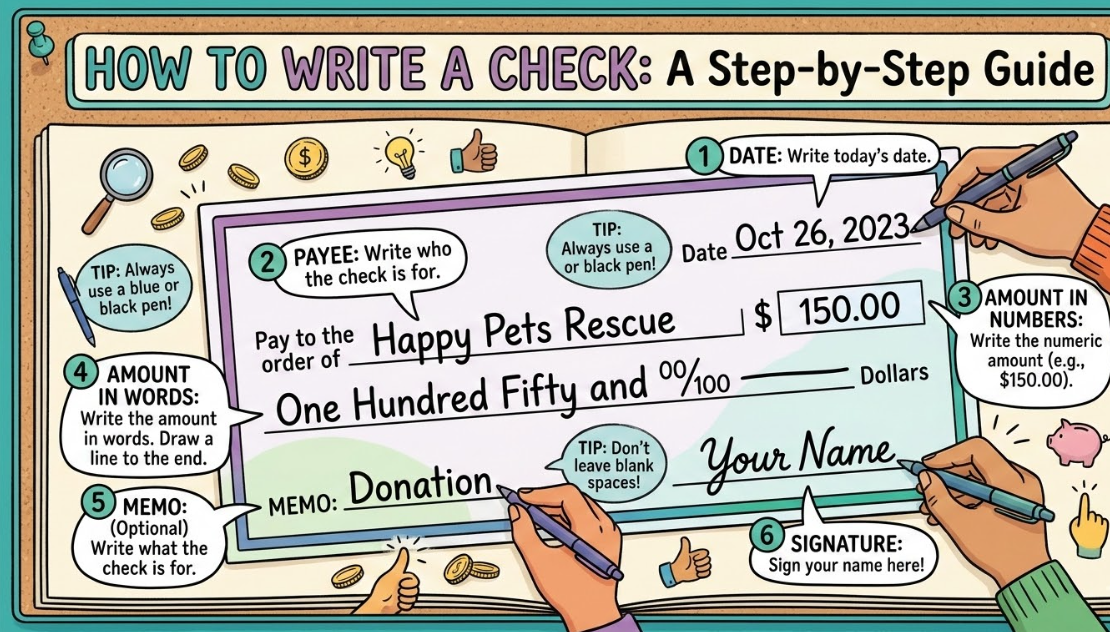
Even in a world of cards, bank transfers, and mobile wallets, knowing how to write a check is still a practical money skill. Landlords, schools, government offices, contractors, charities, and some small businesses still accept or require paper checks. At the same time, checks remain part of the U.S. payment system, even as usage has declined over time, according to the Federal Reserve’s payments research.
This guide explains how to write a check clearly and correctly, whether you need to pay someone else, write a check to yourself, fill out a check for $100, write amounts with cents, or handle larger amounts in the thousands. You will also see a sample check example, practical safety advice, and the most common mistakes that cause delays, returned payments, or fraud issues. That matters because the CFPB says checks may sometimes be processed electronically, and consumers may need to review account statements carefully.
The goal here is simple: help you write a valid check the first time, with confidence, in a way that is useful for real people and aligned with people-first content standards Google recommends for helpful content. Google’s own Search guidance emphasizes creating content for users first, using clear language, useful structure, and reliable information.
What a Check Is and Why It Still Matters
A check is a written instruction telling your bank or credit union to pay a specific amount of money from your account to a person, business, or organization. In plain language, it is a paper payment order. When you sign the check, you authorize the financial institution to transfer those funds if the check is deposited or cashed properly.
Even though checks are not as common as they once were, they still matter for certain transactions. Many people use them for rent, school fees, security deposits, gifts, taxes, reimbursements, childcare, church donations, and payments to service providers who do not accept cards. The Federal Reserve continues to track checks as part of the nation’s noncash payment activity, which shows they are still relevant enough to measure and manage.
Checks also create a paper trail. That can be helpful when you want a record of who was paid, for what purpose, and on what date. In some cases, that record becomes important if there is a dispute. The CFPB notes that if a check amount is altered or if a merchant loses a check, consumers may need to contact their bank quickly and take action such as requesting a stop payment.
So while checks may feel old-school, the skill is still useful. Knowing exactly how to fill one out prevents simple but expensive errors.
How to Write a Check Step by Step
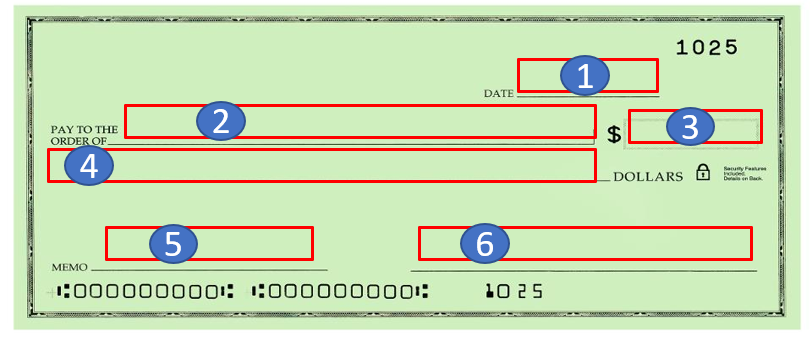
If you have never done it before, the process is easier than it looks. Every standard personal check includes the same core sections. Fill them out in ink, write clearly, and avoid leaving extra space that someone could alter later.
Step 1: Write the Date
At the top right corner of the check, write the current date. In the U.S., that is commonly written as month/day/year, such as 03/07/2026 or March 7, 2026. Using the full month can make the date clearer and easier to read.
The date matters because it establishes when the check was written. It also helps you track payments in your register or banking app. A missing or unclear date can create confusion, especially if the check is deposited later than expected.
Some people try to “postdate” checks by writing a future date. Banks may still process a check depending on their policies and applicable rules, so do not assume a future date guarantees that the check cannot be cashed early. If timing matters, speak with your bank directly before relying on postdating.
Step 2: Write the Payee’s Name
On the line that begins with Pay to the Order of, write the name of the person or business receiving the money. This is called the payee line.
Be precise. If you are paying a person, use their full legal name if possible. If you are paying a company, use the exact business name they gave you. A small mismatch can cause problems when the recipient tries to deposit the check.
This is the step many people mean when they search how to write a check to someone. The answer is straightforward: put that person’s or company’s name on the payee line exactly as it should appear for deposit.
Step 3: Write the Amount in Numbers
In the small box on the right side of the check, write the payment amount in numbers. For example, if you are paying one hundred dollars, write 100.00.
Always include cents, even if the amount is a whole number. Writing two decimal places makes the amount clearer and harder to alter. So instead of writing 100, write 100.00.
This numeric amount should match the written amount you place on the next line.
Step 4: Write the Amount in Words
On the long line below the payee line, write the amount in words. For example, if the check is for $100, write:
One hundred and 00/100
This written line helps verify the legal amount of the check. If the numeric amount and the written amount do not match, banks often rely on the written amount.
Many people searching how to write a check with cents get stuck here. The easiest format is to write the dollar amount in words and the cents as a fraction over 100. For instance:
Forty-five and 67/100
One thousand two hundred and 05/100
Step 5: Add the Memo
In the lower left corner, there is usually a memo line. This part is optional, but it is useful. You can write the purpose of the payment, such as:
Rent for March
Invoice 2048
Birthday gift
Utility bill
Account #123456
A clear memo line helps both you and the recipient remember why the check was written.
Step 6: Sign the Check
In the lower right corner, sign your name exactly as your bank expects it. Without your signature, the check is generally not valid.
Use the same signature style you use for your bank account. Once signed, the check becomes negotiable, which is one reason you should not sign blank checks or leave completed checks lying around.
Also Read:- How to Change a Tire: A Complete Step-by-Step Guide for Cars, Trucks, Bikes, and Emergencies
How to Write a Check With Cents
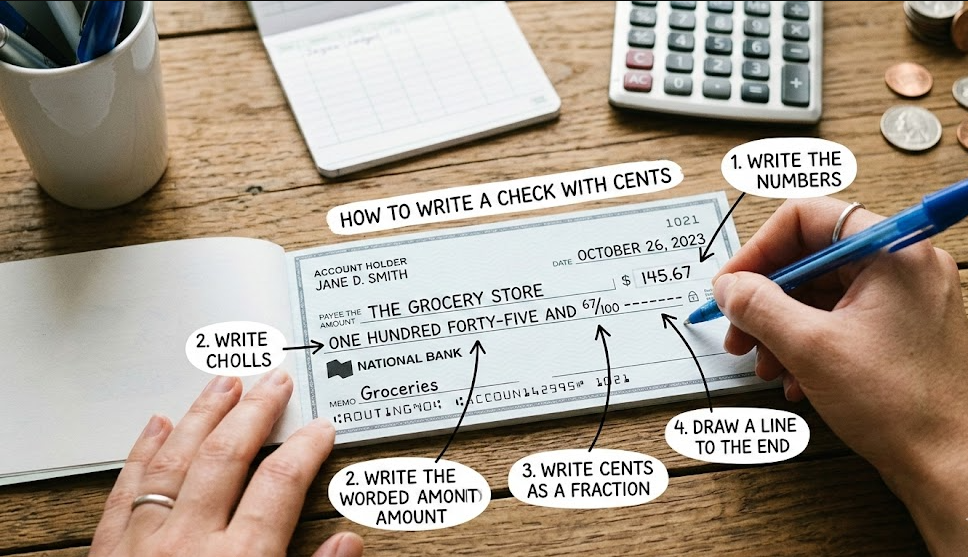
Writing cents is where many people hesitate, but the rule is simple. You write the numbers in the box as usual, then express the cents as a fraction over 100 on the written line.
Here is the pattern:
Numeric box: 42.75
Written line: Forty-two and 75/100
That format works because one dollar equals 100 cents. The fraction format is standard and easy for banks to read. You can also write Forty-two dollars and 75/100, but many personal checks are written without the word “dollars” because the printed check design already implies the currency.
For example, if you want to know how to write a check for $100.25, do it like this:
Numeric box: 100.25
Written line: One hundred and 25/100
If you are writing a small exact amount like $8.03, write:
Numeric box: 8.03
Written line: Eight and 03/100
Notice that even one-digit cent amounts should use two digits. So three cents becomes 03/100, not 3/100.
Also Read:- How to Make Brown Sugar: The Complete Home Guide
How to Write a Check Without Cents
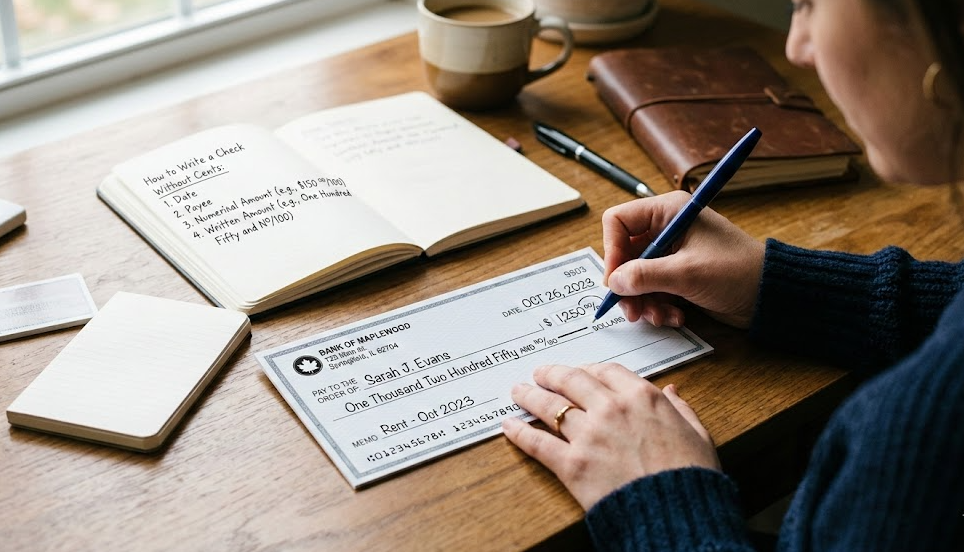
If the amount has no cents, you still need to make that clear so no one can add them later. That is why people search how to write a check without cents.
Use this structure:
Numeric box: 250.00
Written line: Two hundred fifty and 00/100
Some people write Only at the end, like this:
Two hundred fifty and 00/100 only
That is not required, but it can help prevent extra writing from being added after your amount.
If you are writing exactly one thousand dollars, the clean version is:
Numeric box: 1000.00
Written line: One thousand and 00/100
Also Read:- How to Convert Meters to Feet
How to Write a Check in the Thousands
Larger amounts intimidate people, but the principle stays the same. Write the number carefully in the box, then spell out the full amount on the line.
Here are examples for how to write a check with thousands and cents:
$1,250.75 becomes
Numeric box: 1250.75
Written line: One thousand two hundred fifty and 75/100
$3,005.10 becomes
Numeric box: 3005.10
Written line: Three thousand five and 10/100
$10,000.00 becomes
Numeric box: 10000.00
Written line: Ten thousand and 00/100
If you are unsure where commas belong, remember that the written line usually does not need commas. Just write the words naturally and clearly. The key is accuracy, not decoration.
This also answers searches such as how to write a check in the thousands and how to write a check with thousands and cents. Break the number into its word form, then add the cents as a fraction over 100.
Also Read:- How to Convert 70 Meters to Feet
Sample How to Write a Check
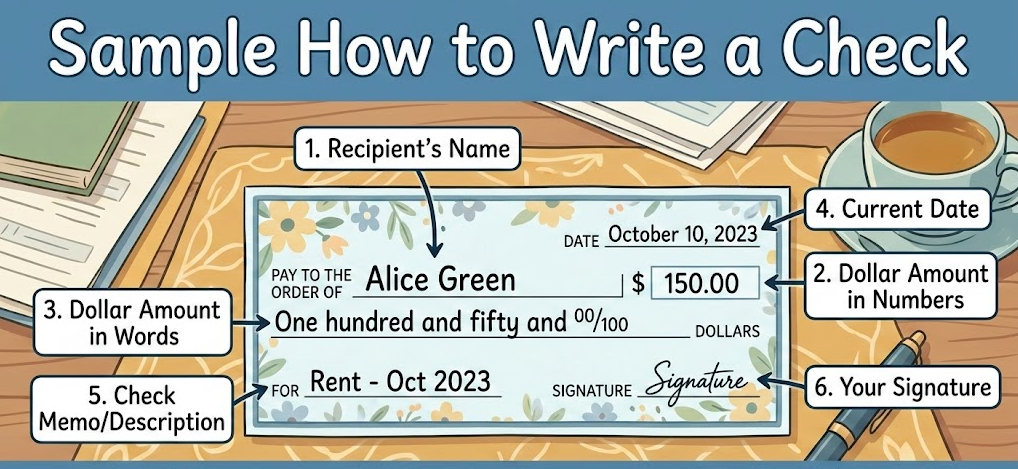
Seeing a model makes the whole process easier. Here is a plain-text sample.
Date: March 7, 2026
Pay to the Order of: John Smith
Amount box: 100.00
Amount line: One hundred and 00/100
Memo: Lawn service
Signature: Your normal bank signature
Here is another how to write a check example for a larger amount:
Date: March 7, 2026
Pay to the Order of: ABC Plumbing LLC
Amount box: 1250.50
Amount line: One thousand two hundred fifty and 50/100
Memo: Invoice 8841
Signature: Your signature
And one more for cents:
Date: March 7, 2026
Pay to the Order of: City Water Department
Amount box: 87.34
Amount line: Eighty-seven and 34/100
Memo: Account 456712
Signature: Your signature
If you are teaching a teenager or helping an older relative, copying a sample format like this is usually the fastest way to build confidence.
Also Read:- Understanding How to Convert Minutes to Hours
How to Write a Check for $100 and $1,000
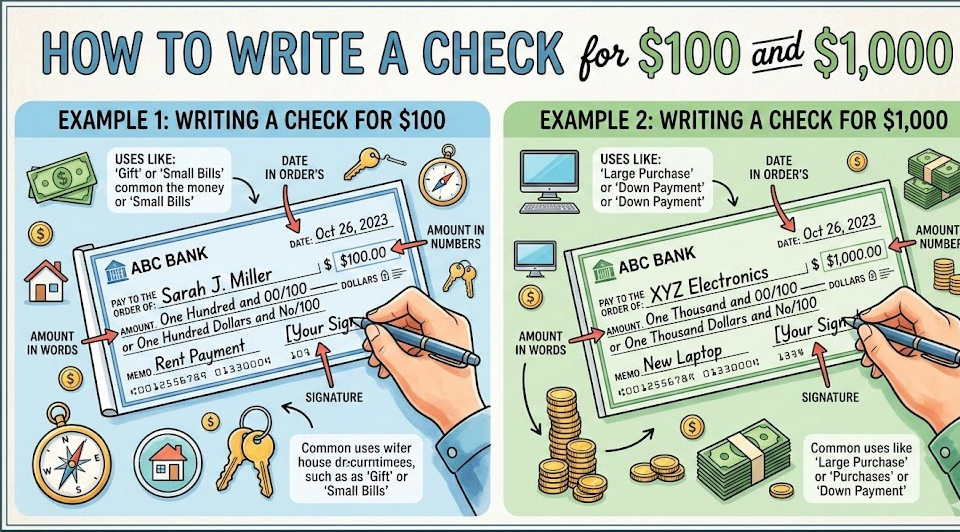
Two of the most common search phrases are how to write a check for $100 and how to write a check for 1000. Here are the exact formats.
For $100:
Amount box: 100.00
Amount line: One hundred and 00/100
For $1,000:
Amount box: 1000.00
Amount line: One thousand and 00/100
For $1,000.50:
Amount box: 1000.50
Amount line: One thousand and 50/100
A common mistake is writing One thousand dollars and leaving the rest of the line open. Draw a line through the unused space after the written amount so no one can add extra words.
Also Read:- How to Convert 56 cm to Inches in Seconds
How to Write a Check to Yourself
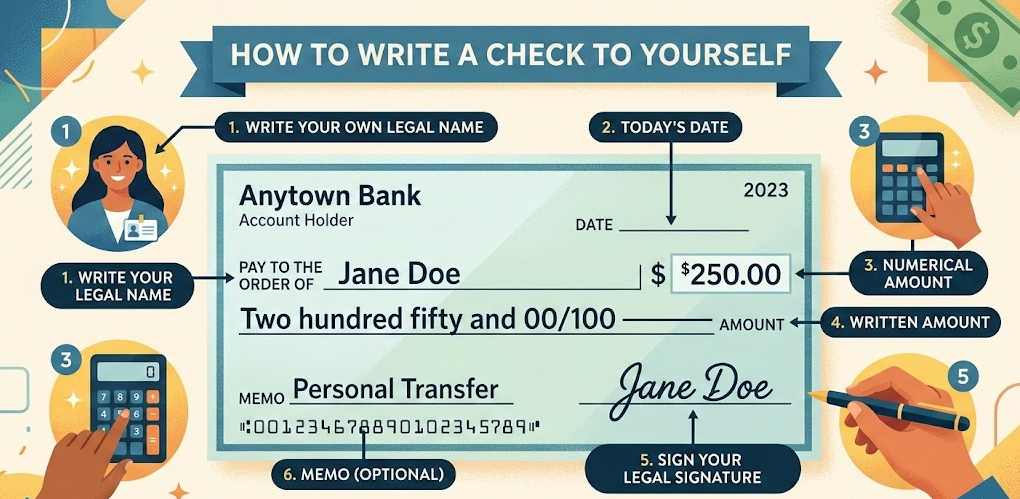
Yes, you can write a check to yourself. This is common when moving money between accounts, making a mobile deposit, or withdrawing funds from one account into another. That is what people mean when they search how to write a check to yourself.
To do it, write your own name on the payee line. Then fill out the rest of the check as normal. After that, you can deposit it into another account you own, assuming your bank accepts that method.
Example:
Pay to the Order of: Your Full Name
Amount box: 500.00
Amount line: Five hundred and 00/100
Be careful not to endorse the back until you are ready to deposit it, especially if you are using mobile deposit. Some banks also have endorsement instructions, such as writing “For mobile deposit only.”
Also Read:- How to Convert ML to Cups (Complete Step-by-Step Guide)
How to Write a Check for Cash
Many people ask how to write a check for cash. Technically, you can write Cash on the payee line, and whoever holds the check may be able to cash it. That is why this method is risky.
If you lose a check made out to Cash, someone else may be able to use it. In most situations, writing the check to yourself is safer than writing it to cash. If you need physical currency, consider using an ATM or visiting your bank branch instead.
If you must write a check for cash, do it carefully, keep control of it at all times, and avoid mailing it. Mail theft and check washing remain real fraud concerns, and the U.S. Postal Inspection Service advises people to protect checks in the mail and report suspected mail theft promptly.
How to Write a Check Online
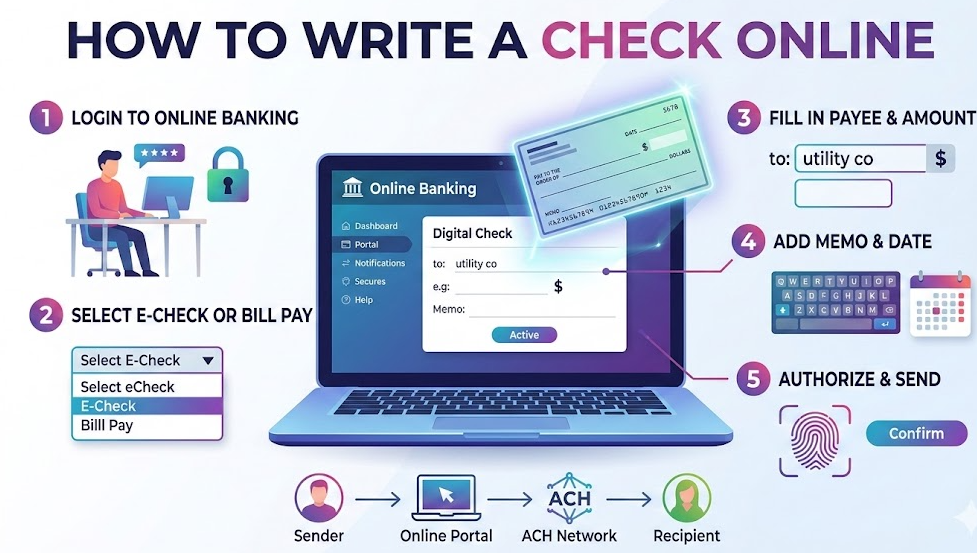
People also search how to write a check online, but this phrase can mean two different things.
The first meaning is ordering or sending a paper check through your bank’s online bill pay service. In that case, you usually do not handwrite anything at all. You enter the payee, amount, and mailing details online, and the bank either sends an electronic payment or mails a physical check on your behalf. This is often the easiest option for recurring bills.
The second meaning is filling in a digital image or template of a check. That is generally not the same as using a real bank-issued check, and it may not be accepted. For personal payments, the safest method is either a genuine paper check from your checkbook or your bank’s bill pay system.
If a company converts your check to an ACH or other electronic transaction, that can also affect how the payment appears on your statement. Nacha documentation describes how eligible source documents can be converted into ACH entries in certain contexts, and the CFPB notes that statements often indicate whether a payment was processed electronically.
Also Read:- How to Convert cm to Inche – Simple Formula & Examples
Conclusion
Knowing how to write a check is still a valuable life skill. Once you understand the six core fields—date, payee, numeric amount, written amount, memo, and signature—the process becomes routine. Whether you need to write a check with cents, write a check for $100 or $1,000, write one to yourself, or handle a payment in the thousands, the structure stays the same.
The smartest approach is to be clear, consistent, and careful. Match the numbers and words, fill out every required line, avoid open space, and monitor your account after the check is issued. That combination helps you avoid errors and reduce fraud risk.
A well-written check is simple, but sloppy details can cause unnecessary trouble. Done properly, it remains one of the most reliable paper payment methods available.
FAQs About How to Write a Check
How do I write $1,500.75 on a check?
Write 1500.75 in the amount box and One thousand five hundred and 75/100 on the written line.
What if I make a mistake on a check?
If the mistake is small and your bank allows corrections, you may be able to write the correct information neatly and initial it. But the safest option is usually to void the check and start over with a new one.
Can I use a pencil to write a check?
No. Use permanent ink. Pencil can be erased or altered too easily.
Does the memo line matter?
It is usually optional, but it can be very helpful for recordkeeping and for identifying the purpose of the payment.
Can I write a check to myself and cash it?
Yes, in many cases. You can write the check to yourself and cash or deposit it, subject to your bank’s policies and identification requirements.
Is writing a check to cash a bad idea?
It is riskier than writing a check to a named person or to yourself. If it gets lost, the wrong person may be able to use it.
Which amount controls if the words and numbers do not match?
Banks often rely on the written amount, which is why spelling out the amount correctly matters.
Can a check be processed electronically?
Yes. The CFPB says some checks may appear on statements as electronic transfers such as ACH payments instead of traditional paper-check processing.
Are checks still widely used?
They are less common than before, but they are still part of the U.S. payments system and continue to be tracked by the Federal Reserve.
How can I reduce the risk of check fraud?
Use ink, avoid blank spaces, mail checks securely, watch your bank account, and report suspicious activity quickly. The Postal Inspection Service and FTC both provide fraud-reporting guidance.
For More UpdateS Visit: Accurate Unit Convert












Leave a Reply