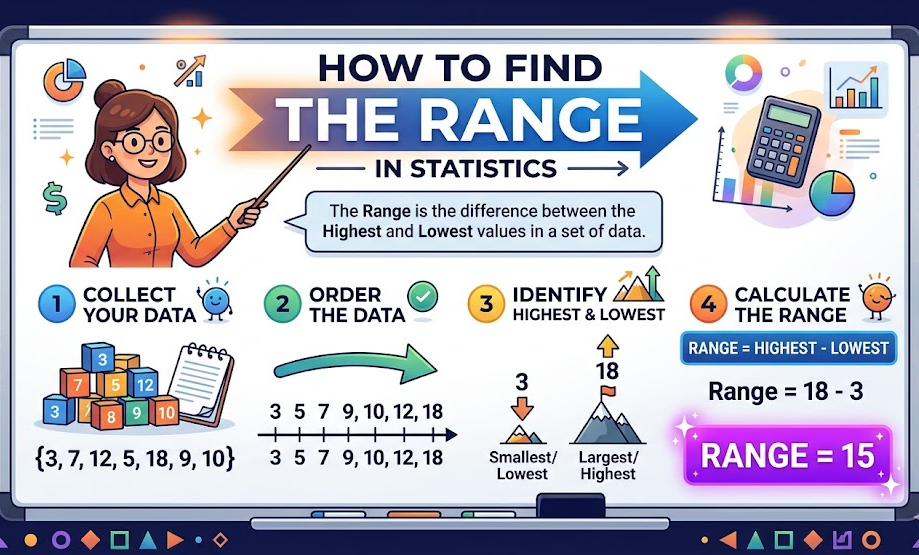
Learning how to find the range is one of the most essential concepts in mathematics. It helps you understand how values are spread out, whether you are working with simple numbers, analyzing a data set, or solving algebraic functions.
The concept of range is widely used in statistics, algebra, and real life situations such as measuring temperature differences or comparing exam results. What makes it powerful is its simplicity combined with its usefulness.
In this complete guide, you will learn how to find the range in math using clear formulas and examples. You will explore how to find the range of numbers, how to find the range of a data set, how to find the range of a graph, and how to find the range of a function including quadratic, parabola, and rational functions.
Range Formula in Math
At its core, the range is calculated using a simple formula that applies in most situations.
Range=Maximum Value−Minimum Value
This formula is the foundation for understanding how to find the range of numbers and data sets. It shows that the range is simply the difference between the highest and lowest values.
How to Find the Range of Numbers
To understand how to find the range of numbers, you apply the formula directly.
For example, consider the values 5, 9, 2, 14, and 7. First identify the maximum value, which is 14, and the minimum value, which is 2. Then substitute into the formula.
Range=14−2=12
This shows that the range of the numbers is 12.
How to Find the Range of a Data Set
When working with a data set, the same formula applies, but you may need to organize the data first.
Consider a data set of marks such as 40, 55, 63, 71, and 85. The maximum value is 85 and the minimum value is 40. Applying the formula gives:
Range=85−40=45
This explains how to find the range of a data set clearly and accurately.
How to Find the Range on a Dot Plot
A dot plot visually represents data, but the formula remains the same. You simply identify the smallest and largest values shown.
If the smallest value is 3 and the largest value is 11, then:
Range=11−3=8
This is how to find the range on a dot plot using the same mathematical principle.
Also Read:- How to Convert Radians to Degrees (Easy Guide)
How to Find the Range of a Graph
When working with graphs, the concept changes slightly. Instead of subtracting values, you describe all possible y values.
If a graph has a lowest point at negative 2 and a highest point at 6, the range is written as an interval.
−2≤y≤6
This method shows how to find the range of a graph using inequality notation.
How to Find the Range of a Function
To understand how to find the range of a function, you determine all possible output values.
For simple functions, you can substitute values or analyze the structure. For more complex functions, algebraic manipulation or graphing is required.
Example, if a function always produces values greater than or equal to 1, the range can be written as:
y≥1
How to Find the Range of a Quadratic Function
Quadratic functions follow a standard form:
y=ax2+bx+c
a
b
c-10-8-6-4-224681020406080100120
To find the range, you must identify the vertex using the formula:
x=2a−b
Once you find the vertex, substitute this value into the equation to find the minimum or maximum value of y.
For example, for the function y equals x squared minus 4, the lowest value is negative 4, so the range is:
y≥−4
How to Find the Range of a Parabola
A parabola can also be written in vertex form:
y=a(x−h)2+k
a
h
k-10-8-6-4-224681020406080100120
In this equation, k represents the minimum or maximum value depending on the direction of the parabola.
If the parabola opens upward, the range is:
y≥k
If it opens downward, the range is:
y≤k
How to Find the Range of a Rational Function
Rational functions often require algebraic manipulation. A common method is to set the function equal to y and solve for x.
For example:
y=x−2x+1-10-8-6-4-2246810-4-2246
Rearranging gives:
x=y−12y+1
Here, y cannot equal 1 because it would make the denominator zero. Therefore, the range is:
y=1
Why Range Matters in Real Life
Understanding how to find the range in math helps in analyzing real world situations. It allows you to quickly measure variation and compare values.
For example, if daily temperatures vary from 18 to 32 degrees, the range can be calculated using the formula to show the difference clearly.
Conclusion
Learning how to find the range becomes much easier when you understand and apply the correct formulas. Whether you are working with numbers, data sets, graphs, or functions, the concept remains consistent.
By using formulas such as maximum minus minimum for data and inequality expressions for graphs and functions, you can confidently solve a wide variety of problems.
With practice, these methods will become natural, helping you succeed in both academic and practical applications.
FAQs
What is the main formula to find the range
The main formula is maximum value minus minimum value.
How to find the range of a function
You determine all possible output values using algebra or graphs.
How to find the range of a quadratic function
Find the vertex using minus b over 2a and determine the minimum or maximum value.
Can the range be negative
The range itself is always zero or positive because it is a difference.
Why are formulas important for finding range
Formulas make calculations faster, more accurate, and easier to understand.
For More Visit Accurate Unit Convert