
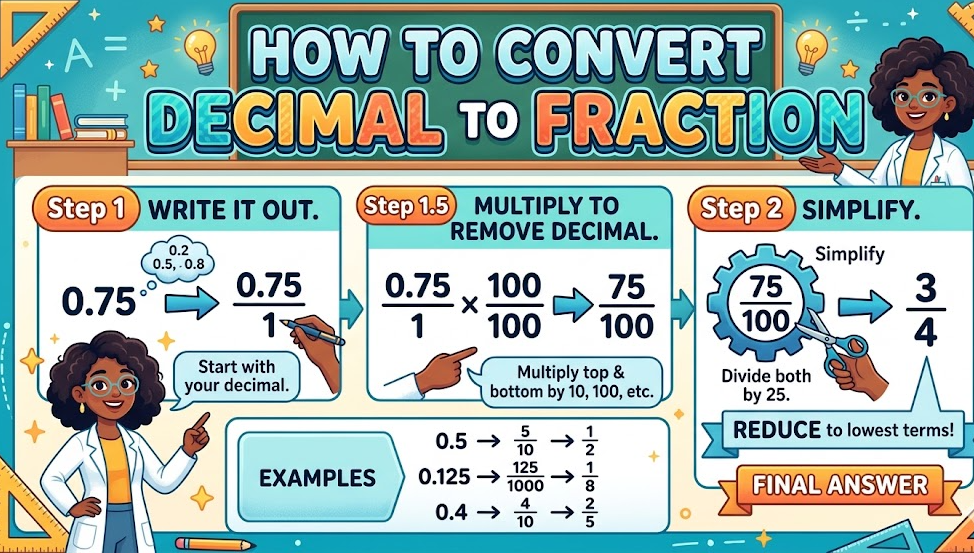
Understanding how to convert decimal to fraction is a fundamental math skill that applies to everyday life, academics, and even professional fields like engineering and finance. Whether you’re simplifying measurements, solving equations, or working with data, converting decimals into fractions helps you achieve precise results.
This comprehensive guide will walk you through everything you need to know—from basic concepts to advanced methods, including how to convert decimal to fraction step by step, using calculators, Excel, Desmos, and specific devices like the TI-84 Plus and TI-30X IIS.
By the end of this article, you’ll not only understand the process but also feel confident applying it in real-world scenarios.
What Is a Decimal and a Fraction?
Before diving into conversion methods, it’s important to understand the basics.
A decimal represents a number based on powers of 10. For example:
- 0.5
- 1.25
- 0.333
A fraction represents a part of a whole using a numerator and denominator:
- 1/2
- 5/4
- 1/3
Decimals and fractions are simply two different ways of expressing the same value.
Also Read:- https://accurateunitconvert.com/how-to-convert-14-meters-to-feet/
Why Learn How to Convert Decimal to Fraction?
Learning how to convert decimal to fraction is useful because:
- Fractions often provide exact values, while decimals can be approximations.
- Many math problems require answers in fraction form.
- It improves understanding of ratios and proportions.
- It’s essential in algebra, geometry, and data analysis.
How to Convert Decimal to Fraction Step by Step
Let’s start with the most important method: manual conversion.
Step 1: Identify the Decimal Type
There are three types of decimals:
- Terminating decimals (e.g., 0.75)
- Repeating decimals (e.g., 0.333…)
- Mixed decimals (e.g., 2.5)
Step 2: Write the Decimal as a Fraction
Place the decimal number over a power of 10:
- 0.75 → 75/100
- 0.5 → 5/10
Step 3: Simplify the Fraction
Reduce the fraction to its lowest terms:
- 75/100 = 3/4
- 5/10 = 1/2
Example 1: Convert 0.25
- Step 1: 0.25 = 25/100
- Step 2: Simplify → 1/4
Example 2: Convert 1.75
- Step 1: 1.75 = 175/100
- Step 2: Simplify → 7/4 or 1 3/4
How to Convert Repeating Decimals to Fractions
Repeating decimals require a slightly different approach.
Example: Convert 0.333…
Let:
x = 0.333…
Multiply both sides by 10:
10x = 3.333…
Subtract:
10x − x = 3
9x = 3
x = 1/3
Also Read:- How to Convert 4 Meters to Feet
How to Convert Decimal to Fraction on Calculator
Modern calculators make conversions much easier.
General Method
- Enter the decimal
- Use the fraction or “a b/c” button
- Convert directly to fraction form
Many scientific calculators automatically simplify the result.
This method is ideal for quick calculations, especially during exams or professional work.
How to Convert Decimal to Fraction on TI-84 Plus
The TI-84 Plus calculator is widely used by students.
Steps
- Enter the decimal number
- Press the MATH button
- Select Frac
- Press Enter
The calculator will instantly display the fraction.
Example
0.75 → 3/4
This method is one of the easiest ways to learn how to convert decimal to fraction on TI-84 Plus.
Also Read:- How to Convert 15 Meters to Feet Easy Formula
How to Convert Decimal to Fraction on TI-30X IIS
The TI-30X IIS is another popular calculator.
Steps
- Enter the decimal
- Press the 2nd button
- Press the F↔D key
The result will convert between decimal and fraction.
How to Convert Decimal to Fraction in Desmos
Desmos is a powerful online graphing tool.
Steps
- Open Desmos calculator
- Type the decimal (e.g., 0.125)
- Press Enter
Desmos automatically converts it into a fraction when possible.
This is particularly useful for students working with graphs and equations.
How to Convert Decimal to Fraction in Excel
Microsoft Excel is widely used for data analysis.
Method 1: Format Cells
- Enter the decimal value
- Right-click → Format Cells
- Choose “Fraction”
Method 2: Use Formula
You can use functions or custom formulas to approximate fractions.
Example:
- =TEXT(A1,”# ?/?”)
Excel is especially useful when handling large datasets.
Converting Mixed Decimals to Fractions
Mixed decimals include a whole number and a decimal.
Example: Convert 2.75
- Step 1: Convert decimal part → 0.75 = 3/4
- Step 2: Combine → 2 3/4
Or:
- 2.75 = 275/100 → 11/4
Real-Life Applications of Decimal to Fraction Conversion
Understanding this concept has real-world benefits:
Cooking
Recipes often require fractions instead of decimals.
Construction
Measurements must be precise, often in fractional form.
Finance
Interest rates and ratios may require conversions.
Education
Standardized tests frequently include fraction problems.
Tips to Master Decimal to Fraction Conversion
- Practice regularly with different types of decimals
- Memorize common conversions (0.5 = 1/2, 0.25 = 1/4)
- Use calculators for verification
- Understand the logic instead of memorizing steps
Advanced Examples
1 Example: Convert 0.625
- 0.625 = 625/1000
- Simplify → 5/8
2 Example: Convert 0.2
- 0.2 = 2/10
- Simplify → 1/5
3 Example: Convert 0.875
- 0.875 = 875/1000
- Simplify → 7/8
Conclusion
Learning how to convert decimal to fraction is an essential mathematical skill that combines logic, precision, and practice. Whether you’re solving homework problems, working with measurements, or analyzing data, mastering this skill will make your work more accurate and efficient.
From manual step-by-step methods to advanced tools like Excel, Desmos, and scientific calculators such as the TI-84 Plus and TI-30X IIS, there are multiple ways to approach conversion depending on your needs.
With consistent practice and a clear understanding of the underlying concepts, anyone can become proficient in converting decimals to fractions.
For More UpdateS Visit: Accurate Unit Convert














Leave a Reply